The Al-Qurna College of Education at the University of Basrah has achieved a new scientific milestone through the contribution of one of its faculty members, Assistant Professor Dr. Adnan Badr Ghalib, in publishing a scientific study in an international journal published by Wiley and indexed within Scopus and Clarivate with an impact factor of 3 and a CiteScore of 4.
The study was titled:
“Bioremediation Mechanisms of Methyl Orange by Ceriporia lacerata RF-7: From Characterization of Nanoporous Surfaces to Spontaneous Thermodynamics”
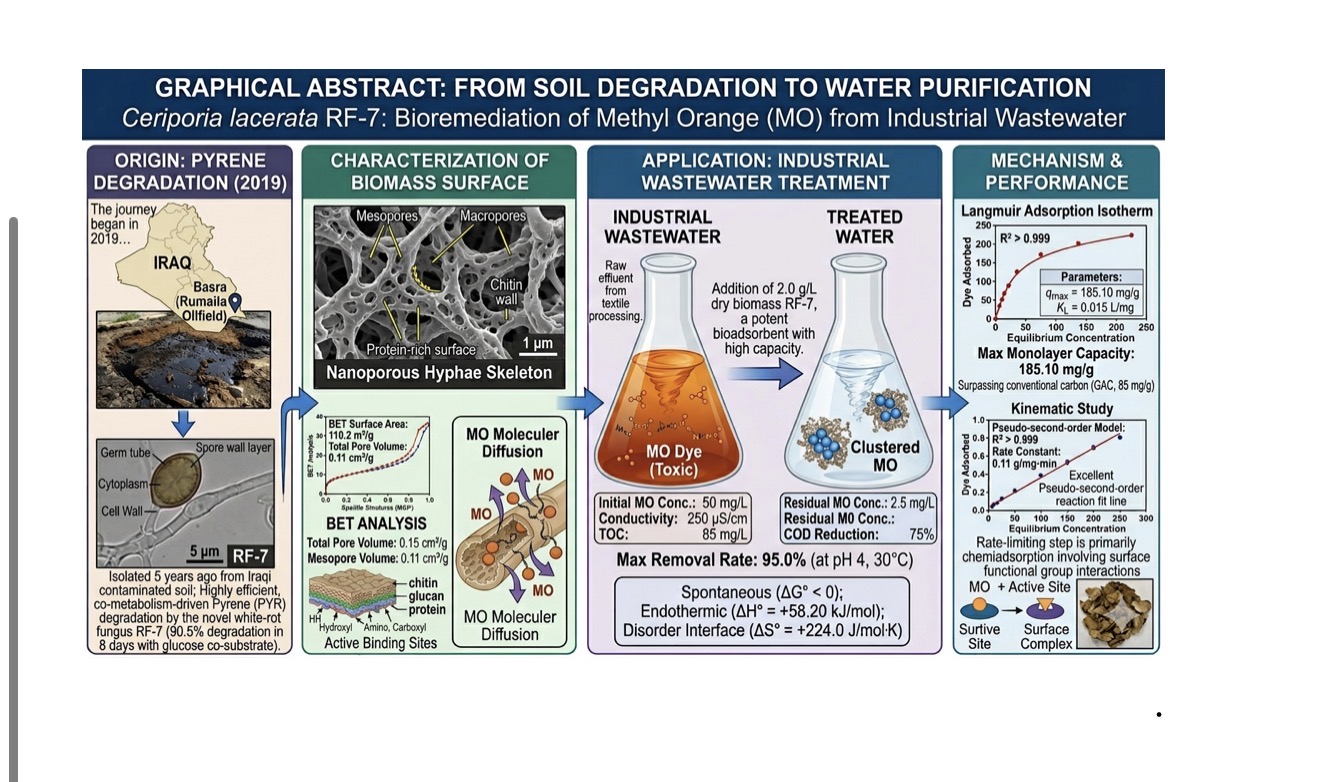
The study represents an extension of a research program initiated by the researcher five years ago, as he utilized the fungal strain Ceriporia lacerata RF-7, which was previously isolated from contaminated soil in the Rumaila oil field and is known for its ability to degrade complex aromatic hydrocarbon compounds, to develop an innovative biotechnology based on repurposing the dry biomass of the fungus for the treatment of contaminated water.
The results of the study demonstrated the success of the fungus-derived bio-sorbent in removing the industrial dye Methyl Orange from water with an efficiency of 95%, and electron microscopy tests revealed that the biomass possesses a network of nanopores that provide a large surface area, which contributed to increasing the pollutant adsorption efficiency compared to many traditional materials used in this field.
The strain also recorded, according to the Langmuir model, a monolayer adsorption capacity of 185.10, qualifying it to be a sustainable and eco-friendly biological alternative in contaminated water treatment applications at the industrial level, while reducing operational costs and energy consumption.
This achievement embodies the orientation of the University of Basrah toward supporting applied scientific research and harnessing its outputs to find innovative solutions to environmental challenges, in line with the sustainable development goals and enhancing the university’s position in international scientific forums.
Important News



viewed most