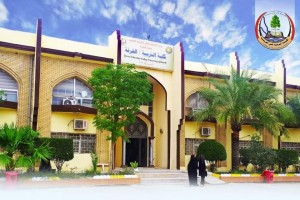
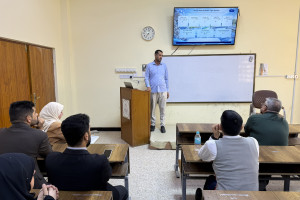
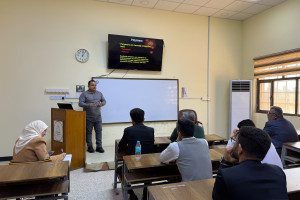
The Department of Chemistry at the College of Education in Qurna, University of Basrah, organized a preliminary seminar presented by the student Subhan Hussein Mustafa, titled: "The Use of Zinc Oxide, Magnetic Iron Oxide, and Graphene Nanostructures for the Removal of Organic Pollutants from Water."
The seminar addressed the problem of water contamination by organic pollutants—particularly dyes, pharmaceutical residues, and pesticides—and their environmental and health impacts, highlighting the role of modern nanotechnology in advancing contaminated water treatment methods.
It also reviewed the structural and physicochemical properties of the nanomaterials, specifically zinc oxide (\text{ZnO}), magnetic iron oxide (\text{Fe}_3\text{O}_4), and graphene, demonstrating their role in enhancing organic pollutant removal efficiency through adsorption, photocatalysis, and advanced oxidation processes (AOPs).
Furthermore, the seminar covered synthesis methods for nanomaterials, the factors influencing removal efficiency, as well as the characterization and analytical techniques used to evaluate their properties, alongside practical applications of these materials in treating water contaminated with pharmaceutical pollutants and organic dyes.
It also discussed the importance of recovering and reusing nanomaterials, environmental safety considerations, and potential toxicological effects, in addition to the major technical challenges facing the large-scale application of these materials.
The seminar aimed to highlight the importance of developing multifunctional nanostructures and improving their efficiency and stability, thereby contributing to the advancement of modern water treatment technologies and the reduction of environmental pollution.
Important News
viewed most