A scientific study conducted by a joint research team from the University of Basrah, alongside researchers from the United States and the United Kingdom, has explored the use of nanotechnology for oil recovery at low temperatures. The study featured the participation of Prof. Dr. Adnan Badr Ghaleb Al-Hawash, a faculty member at the College of Education/Al-Qurna at the University of Basrah, as part of an international scientific collaboration aimed at developing advanced techniques for treating oil pollution and enhancing sustainable solutions to protect the marine environment.
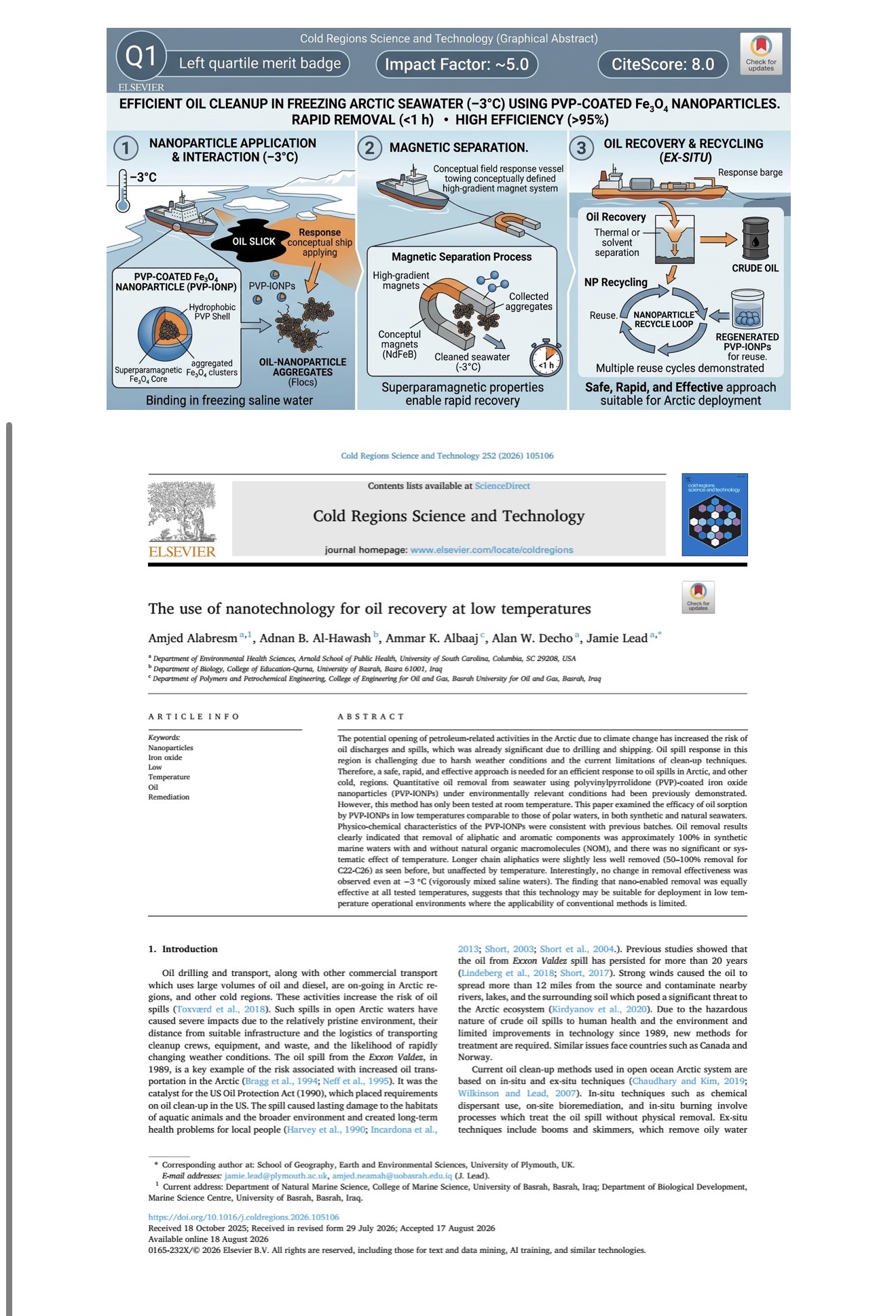
The study, entitled "The Use of Nanotechnology for Oil Recovery at Low Temperatures", was published in the international journal Cold Regions Science and Technology, published by Elsevier and classified within the first quartile (Q1). The journal boasts a CiteScore of 8.0 and an impact factor of approximately 5.0, reflecting the importance of publishing in reputable international scientific journals and enhancing the research presence of the University of Basrah in global academic forums.
The study involved the application of magnetic iron oxide nanoparticles coated with polyvinylpyrrolidone, abbreviated as (PVP-IONPs), for removing oil pollution from seawater. The results demonstrated a high efficiency in removing oil pollutants, ranging between 95–99% within one hour, highlighting the promising potential of this technology in accelerating remediation processes and mitigating the environmental impacts resulting from oil spills.
The study demonstrated the capability of this nanotechnology to operate efficiently at extremely low temperatures, reaching down to three degrees Celsius below zero (-3°C). This represents a significant advancement in addressing oil pollution in cold and polar environments, where traditional methods face major challenges. The study also tested the effectiveness of the technique in natural and synthetic seawater in the presence of organic matter, further reinforcing the significance of the results and their potential applicability in developing environmental applications better suited to real-world conditions.
The study concluded that the use of magnetic nanoparticles represents a promising scientific approach for developing oil pollution treatment methods, owing to their high efficiency in removing pollutants in a short time, as well as their magnetic properties, which offer promising potential for particle separation and recovery. These findings are expected to open new research horizons for developing advanced technologies to protect the marine environment and reduce the risks associated with oil pollution, particularly in regions with harsh climatic conditions.
This achievement comes within the framework of the University of Basrah’s continuous efforts to support scientific research, enhance cooperation with international universities and research institutions, and encourage the publication of scientific outputs in prestigious international journals, thereby consolidating the university's academic standing and highlighting the role of its researchers in providing innovative solutions to contemporary environmental challenges.
Study Link:
https://www.sciencedirect.com/science/article/pii/S0165232X26002880
Important News



viewed most